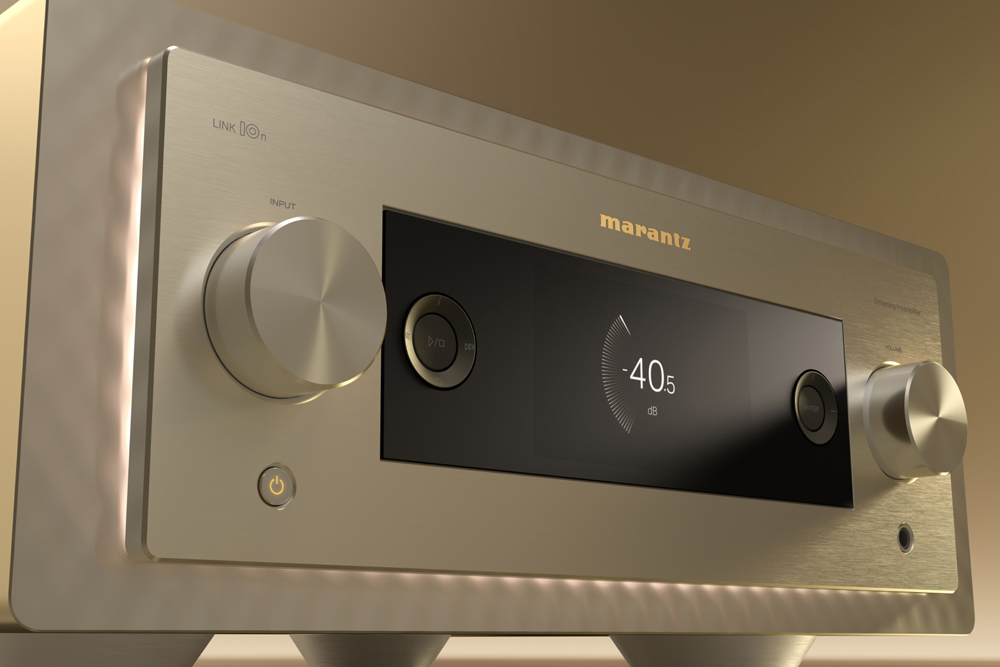
The humble solid state-based preamplifier has gone through what can only be described as a transformation on a radical evolutionary scale. To the point that simply calling it a preamp would be like reducing hypercomplex analysis down to a simple algebraic formula. Once not much more than a switching and volume control device, advancing technologies have transformed preamps into a platform for features that, not that long ago, were not even imagined. Since the early naughts, the technology gap between a traditional preamp and its contemporary counterpart has evolved to a point which is like comparing a Model T to a software-bulged self-driving computer on wheels. Reflecting its membership in the exclusive ‘10 series’ club, Marantz’s LINK 10n is an exemplar of exhaustive features packaged in flagship-grade construction. So, contrary to old school dogma, can enriched functionality coexist with equally abundant sonic performance to deliver musical joy?
All-Inclusive Package
Shortly after receiving the review sample, Marantz announced firmware update U38 which was designed to improve ergonomics and the way the unit presents its display status, among other things. So, with that improvement in mind, I’ll say it at the outset: the LINK 10n is among the most comprehensively featured products of its kind. In a superbly built and elegantly styled chassis that outweighs some integrated amplifiers, the LINK 10n packs an enormous suite of functions and capabilities that, on their own, could fill a small website.
I’ll get deeper into them bellow, but here are some of the highlights, off the top of my head, as I write: as far as connectivity, the LINK 10n offers analogue balanced and unbalanced inputs, an MM/MC phono stage, preamplifier functionality with the requisite volume control, naturally, preamplifier balanced and unbalanced outputs, subwoofer output (alas, a solitary one), discrete headphone amplifier, streaming capabilities up the wazoo, 12V triggers, a full suite of digital inputs and outputs, HDMI ARC, Bluetooth wireless streaming, and multi-room playback via reliable HEOS. I’ll pick up on the rest anon, when my head stops spinning. Man, that’s some features list.
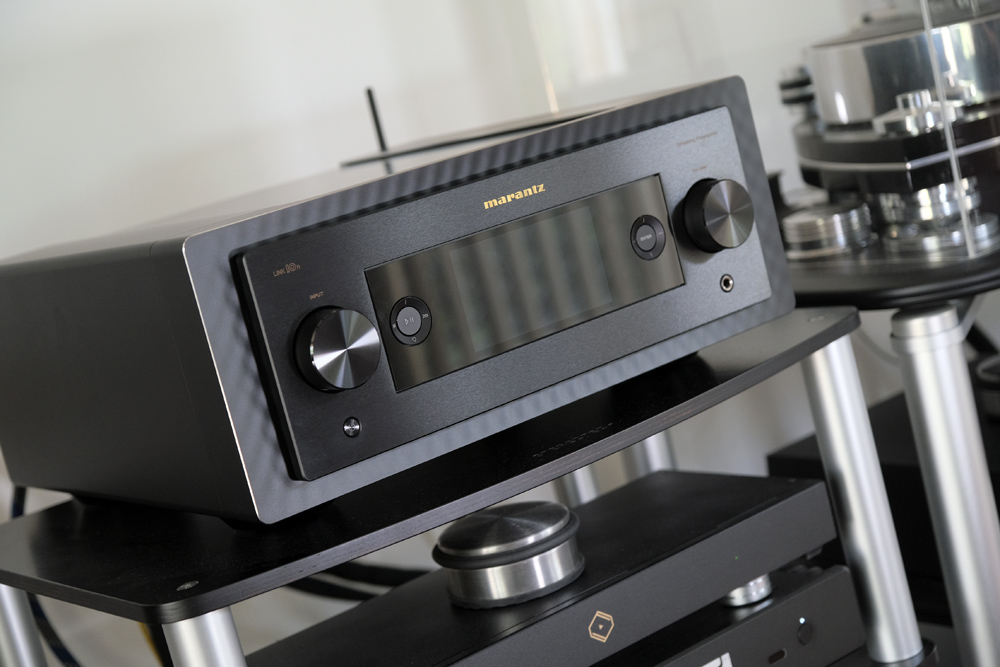
So, before I get into all that, let me just mention that LINK 10n is faultlessly built and beautifully styled in a design language that ties in with the other 10 series products: the outstanding MODEL 10 Reference Integrated Amplifier (reviewed here and here and given both SoundStage! Australia and SoundStage! Network Product of the Year 2025 awards) and the SACD 10 Reference SACD Player.
Available in black or the classic Marantz gold finish, all the LINK 10n’s metalwork, controls, buttons, etc. are solid-gauge, perfectly anodised, precisely machined, and meticulously assembled. Connector quality, switch ‘feel’, and the overall tactility of the user experience is first-class too. That includes the remote control too.
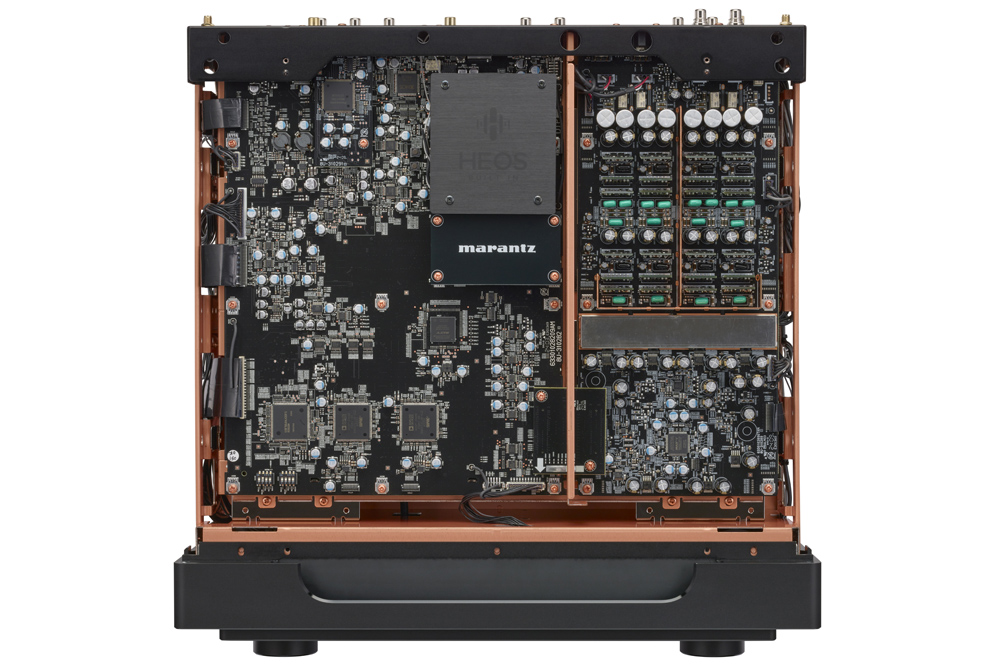
Ditto for the fully balanced topology and precise internal layout which is skilfully engineered. Marantz has once again brought into play its proprietary ‘Hyper Dynamic Amplifier Module’ (HDAM) discrete componentry, eschewing cheaper and easier to implement op-amps, which can also sound inferior, while also incorporating a new bespoke digital-to-analogue conversion scheme.
Try lifting the thing too… Heck, the unit weighs in at a hefty 33 kg, with aluminium panels up to 16 mm thick encasing a triple-layer copper plated sub-chassis. Power amp heft much? Plus, that heavyweight bravado comes via Marantz engineers perfecting the crucial power supply with a relatively large toroidal transformer and a generous sprinkling of premium electronic componentry.
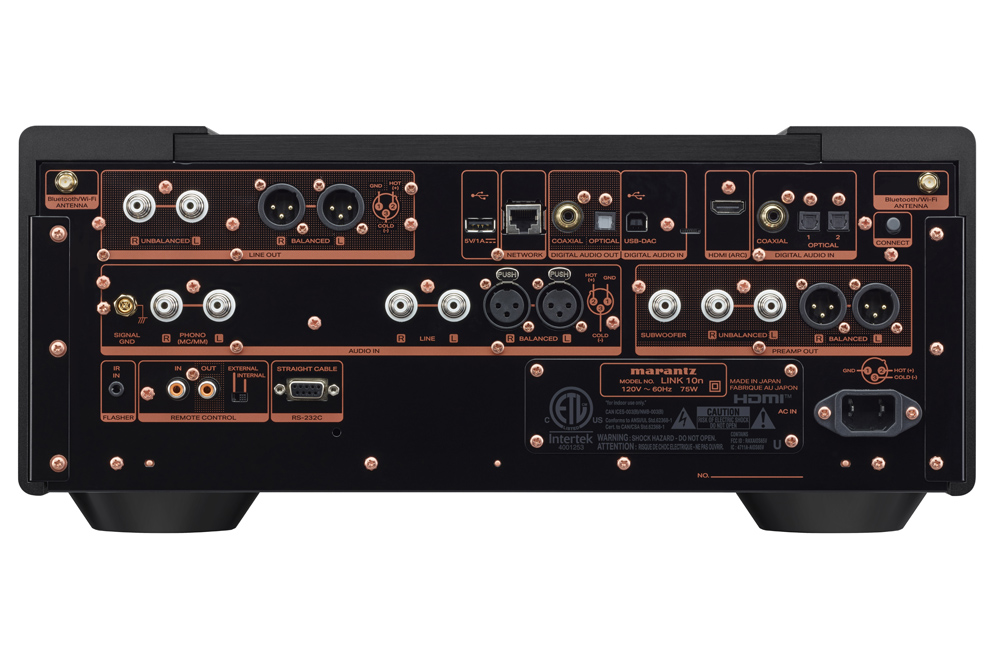
OK, let’s launch into the wide selection of connectivity options. A balanced XLR and unbalanced RCA preamplifier output, fixed analog outputs via a balanced XLR and an unbalanced RCA, one balanced XLR and one unbalanced RCA analogue line input, a Moving Coil (MC) and Moving Magnet (MM) phono stage with impedance options of 32, 100, and 390 ohms for MC and 39 kohms for MM, and an RCA subwoofer output with Low-Pass filter settings at 40 Hz, 60 Hz, 80 Hz, 100 Hz, and 120 Hz (the default is 80 Hz).
On the digital side, now going from left to right, we have an USB-A for external storage devices, RJ45 ethernet network port, an S/P-DIF coaxial RCA and Toslink optical outputs (external DAC connectivity), an asynchronous USB-B digital audio input (external streamer or PC), HDMI-ARC input (TV connectivity), one S/P-DIF RCA coaxial and two Toslink optical inputs (CD Transport or digital device connectivity).
There are two mini-RF antenna sockets on the left-and-right-hand-sides for wireless Bluetooth V5.4 streaming (Wi-Fi at 2.4 GHz and 5 GHz), a Connect switch, and the remote control in/out (governed by an External/Internal switch), 12V trigger, and an RS-232C D-plug socket. Finally, there’s an IEC AC socket.
The front panel houses a 6.5 mm jack output for the built-in headphone amplifier which offers Low, Mid, and High gain settings. I gave my high-end Kennerton Audio, Sony, and Bowers & Wilkins wired headphones a whirl too (wireless headphones are catered to via Bluetooth, of course), finding the headphone amplifier a neutral, dynamic and nicely detailed performer capable of coupling to a variety of headphones at many price points.
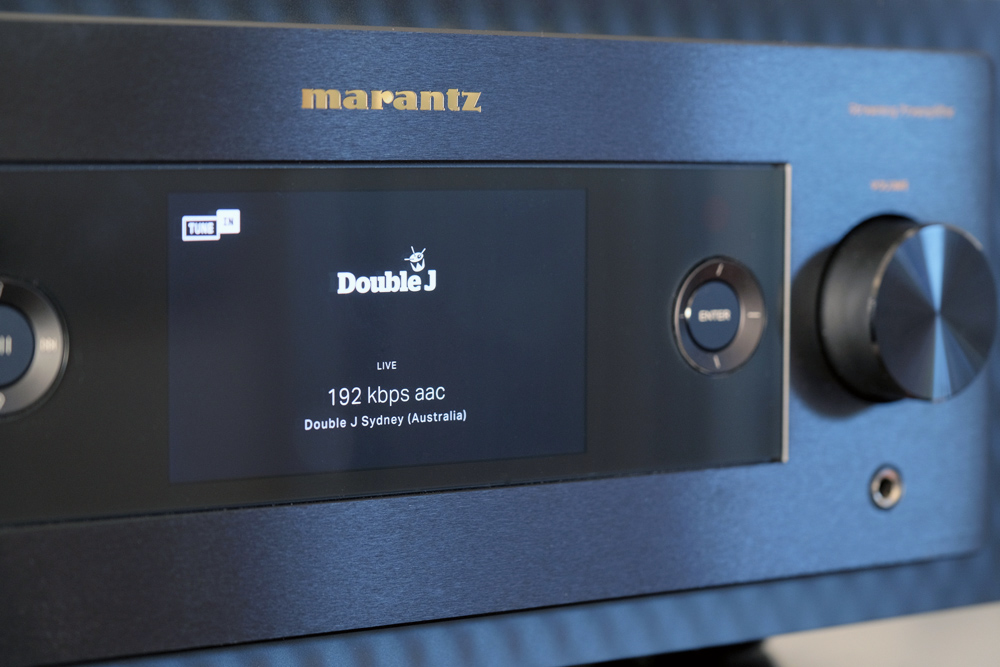
The LINK 10n is Roon Ready, is compatible with Apple AirPlay 2, and offers Spotify, Tidal, Qobuz (and their direct streaming ‘Connect’ options) and many other music provider options. Playlist compilation is now available from streaming services and can even accept playlists from a USB thumb drive. Also available for streaming is the ever expanding and wonderful universe of free internet radio stations.
The LINK 10n houses a high quality digital-to-analogue converter featuring a new proprietary Marantz conversion circuit the company calls MMM-Conversion. MMM-Conversion incorporates MMM-Stream, a sub-system which includes a number of features allowing user sound customisation. The system includes options for setting dither (Setting 1, 2, and Off), noise-shaper (Balanced, Natural, Dynamic Music, and Dynamic Voice), a jitter reducer strategy, and two digital filter options. Oh, and LINK 10n is capable of a just about universal set of file formats.
Broad control of functions and features can be accessed via the free HEOS app (available for iOS and Android) in addition to multi-room and internet radio music playback availability via, in my case, iPhone 17. The LINK 10n can be controlled via its provided remote control, a comprehensive unit which also doubles up as a Roon music playback controller (Pause, Play, Next Track, etc.).
In addition to the information mentioned above, the front panel’s centrally placed high-definition TFT colour display can also be customised in a variety of layouts. These can be as simple or as information-rich as the user desires. For example, when playing Roon, pressing the ‘Enter’ button on the remote control will toggle between a screen showing just album artwork and artist name, while further button presses will cycle through additional data such as file type and resolution, the current input, and much more (the text size and general display character size was tweaked and improved after the U38 firmware update). Plus, the display’s brightness can be dimmed independently, or it can be linked to match the intensity of the fascia’s backlit highlight, itself providing an added level of aesthetic elegance.
The LINK 10n’s provided specifications are… extensive, so I’ll list some key pointers here. Should you require further details, I suggest hitting the Marantz website. So, Marantz states the frequency response to span from 5 Hz to 100 kHz (+0 dB and -3 dB), line output level is given as 2.0 Vrms unbalanced and 4.0 Vrms balanced, harmonic distortion is 0.001% (20 Hz to 20 kHz), Total Harmonic Distortion + Noise (THD+N) for PCM is 0.0015% at 1 kHz (DSD 0.0004%), while the Signal-to-Noise for the line stage is 122 dB and for the phono stage it’s 76 dB for MC and 88 dB for MM.
Digital resolution via USB-B is up to 32-bit/384 kHz PCM while the S/P-DIF RCA coaxial, Toslink optical, and HDMI ARC all cater to 24-bit/192 kHz. DSD offers up to 11.2 MHz/DSD256.
As far as setting up LINK 10n… well, all I can say is that it’s effortless. Truly plug ‘n play. Connecting to the network was a case of immediate recognition by LINK 10n, and away you go. Just start playing music. Through the course of my time with the unit, I tried all music playback configurations. Yeah, zero network issues and zip only-for-IT-geeks issues throughout its extended stay at SoundStage! Australia HQ.
I connected LINK 10n via XLR outputs to my Gryphon Audio Antileon EVO power amplifier while, for the bulk of this evaluation, digital playback was via both my own server and DAC team and also through LINK 10n’s in-built DAC and streaming capabilities. I also fired up the Yamaha CD-S2100 as a disc transport into LINK 10n’s digital input while spending some time spinning vinyl (LINK 10n’s MC phono input). HEOS, and its app of course, opens up multi-room/zone capabilities to wirelessly sample the ample high-resolution sonic treats LINK 10n offers.
Marantz regards the LINK 10n as achieving the finest measured performance of a digital product the company has ever produced. In addition, in an incentive introduced by the late Ken Ishiwata (Ken, you are so missed), the LINK 10n has been tweaked by Yoshinori Ogata, Marantz’s ‘Sound Master’, who has selected key premium components and fine-tuned critical circuitry for enhanced performance.
Mastering Sound
Like I mentioned above, the simple network and HEOS app setup meant that I was ready to spin tunes within approximately 10 minutes, and that included connecting LINK 10n to my electronics. Sweet.
I should note that when auditioning more traditionally, in other words, via my streamer to the USB-B port or playing digital from CD and other wired sources, I disabled the LINK 10n’s Wi-Fi and Bluetooth wireless audio options in order to extract the highest possible audio quality (Marantz, quite rightly, also suggests doing so).
I first auditioned the LINK 10n as a preamplifier with my Totaldac tri-unity DAC connected to a line input and the LINK 10n’s balanced output to Gryphon Audio’s Antileon EVO’s balanced inputs.
LINK 10n is no doubt a clean and neutral preamplifier, however, there’s just a subtle hint of sweetness and added body through the midrange. In my view, this is a very desirable quality, and it has been a hallmark of high quality Marantz electronics since the early days. A ‘House Sound’ if you like. Balancing that midrange weight without influencing a component’s overall neutrality and without shaping the way it delivers detail and pace is a challenging task. That the LINK 10n achieves this unequivocally is a mark of the skills of both Marantz’s engineers and the personnel tasked with ‘voicing’ it. Sound Master indeed.
I recently added Touristes to my Roon library, a great mix of that distinct bluesy Malian guitar sound by Vieux Farka Touré (naturally, influenced by his famous father Ali Farka Touré) and modern vocals by Julia Easterlin. On the traditional folk track “In the Pines” the drum beat that underpins the track was delivered with tight control and satisfying slam. Touré’s mellow tone paid generous respect to Easterlin’s voice, the two blending in a way that complemented the track without intruding on each other’s musical intent.
There was terrific low frequency depth tied in with rhythmic pace and tight attack on Victor Wooten’s virtuosic bass lines in “A Little Rice and Beans” from Wooten’s Trypnotyx album. Ditto for the pace and timing on the toe-tapper “Funky D” – I challenge anyone to keep still while listening to this track. There was excellent separation to the sax, drums and bass lines through the complex instrumental sections.
That midrange (and lower high frequencies, actually) solidity and subtle warmth was beautifully showcased on John Martyn’s cover of Portishead’s “Glory Box” from his album The Church With One Bell. Martyn’s voice sounded heavy and deep, had uncanny presence, and delivered the tension and longing the track aims to communicate. LINK 10n does not falter, providing all the cues required for musical engagement. The drum’s rim shots were super defined and sharp while communicating the sound of the stick’s wood. The bass line that underpins the track was tight, deep and free of any boom or overhang.
For the next stage of my assessment, I switched over to the LINK 10n’s streamer and in-built DAC. In my opinion, the differences between high quality conversion systems can range between subtle and reasonably, but not overwhelmingly apparent, particularly when clever engineering has been applied to the I/V stages and power supplies. Yes, there are notable gains as you climb the price ladder and encounter less cost restricted designs but, again, when thoughtful engineering is applied, the law of diminishing returns kicks in rather quickly. Arbitrarily, at a point between $5K to $10K, the curve slides off a somewhat steep cliff-drop for relatively moderate improvements. That said, at the sweet spot of the DAC space, sound quality can be excellent. There’s no doubt that Marantz designers were all over the critical engineering aspects across the entire 10 series products. So, it’s no wonder, then, that the LINK 10n’s onboard DAC performed superbly.
Playing the same tracks mentioned above revealed that midrange solidity remained intact, a confirmation of the DAC’s inherent neutrality. I had fun listening to the punchy drums, clear vocals, and excellent unravelling of the bombastic portions of “Tesko Suicide” on the Sneaker Pimps’ Becoming X album. Yes, as the track grew more intense through the busier passages, the LINK 10n’s resolution and separation capabilities shone. Skipping to the next track, “6 Underground”, showcased Kelli Dayton’s measured vocals, up-front and centre, soulfully delicate and clearly discerned.
Spatial reproduction by the LINK 10n was very good. There was excellent image height and superb soundstage depth tied to fine width, all on par with other very capable solid state preamplifiers and streamers I’ve experienced. There were spacious soundstages on 200 More Miles, a compilation of the Cowboy Junkies’ live performances across Canada, coast-to-coast USA and the UK at the Royal Albert Hall in London. The LINK 10n’s impressive resolving ability made it a relatively easy task to discern the distinct acoustic signatures of the varied venues, all superbly captured and produced. Singer Margo Timmins’ aural image was sharply delineated and tightly locked-in while the rest of the band occupied their respective positions within the soundstage with excellent image stability. Coincidentally, I caught the band at Sydney’s beautiful Art Deco-styled State Theatre in November 2025… what a night…
Recorded in Munich’s Herkulessaal, Warner Classics’ Mozart: Piano Concertos №s 20 and 27 showed both the beauty, the restrained power and the tonal purity of Evgeny Kissin’s piano as accompanied by the Kremerata Baltica orchestra. Again, the acoustic character of the Herkulessaal bled through with a striking liveness while the LINK 10n’s handling of the piano’s harmonic decay and tonal signature delivered a realistic impression and a lifelike sonic image.
Investigating the dither, noise-shaping and filter options produced varied results in terms of sound differences. In my opinion, these are a set of inherently subjective choices which, simplistically, is like comparing chocolate, vanilla, mango, and pistachio ice cream (all favourites of mine, BTW). That’s not to say there are no differences, it’s just that they are subtle and their effectiveness will also be system dependent. In this case, there’s really no absolute better, there’s just variations of different and totally up to the individual’s palate. So, experiment away…
Conclusion
I’ll have to, again, stress that throughout the listening sessions, which extended for several weeks, the LINK 10n’s features and overall functionality never tripped. Not once.
Sonically, Marantz has made considerable efforts to optimise the sound quality to approach, match, and even surpass some high-end solid state preamplifiers that are basically no more than a source switcher coupled to a volume control.
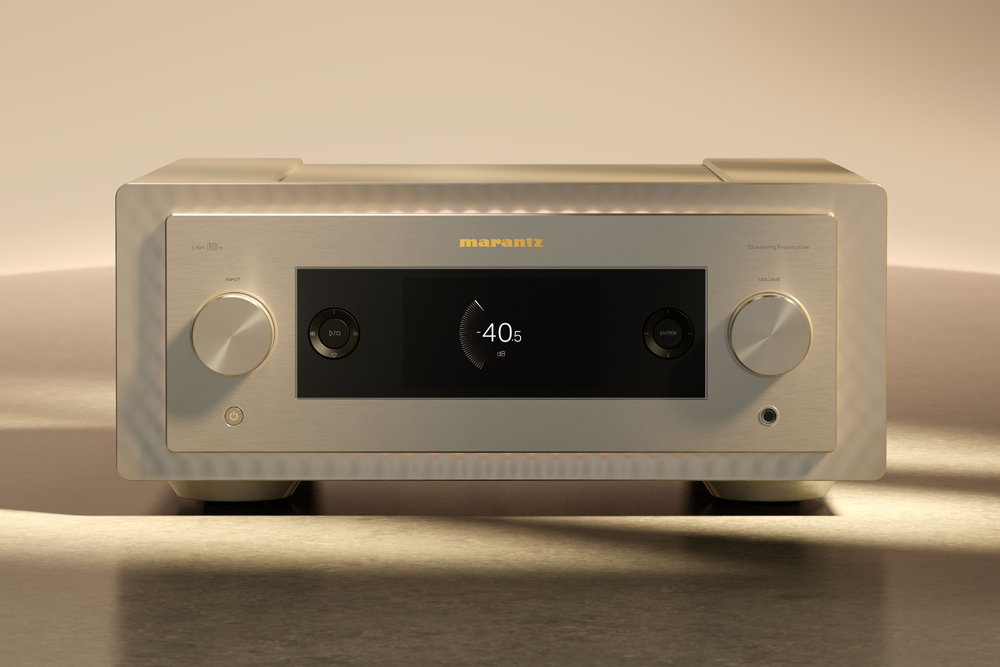
LINK 10n has a feature set and a sonic performance that will satisfy both the tech-head and the pure audiophile. With its inherent rock-solid capabilities, formidable sonic performance (with further gains available via its transparent digital EQ features), along with its elegant styling and luxurious build quality, the LINK 10n stands as yet another triumph in Marantz’s prestigious 10series.
If you’re shopping in this category, go, go, go forth and audition it at a specialist audio establishment… I’d bet you’ll bounce right out with it. Super-highly recommended.
… Edgar Kramer
This email address is being protected from spambots. You need JavaScript enabled to view it.
Associated Equipment
- Speakers — Wilson Audio Alexia V, Axis Loudspeakers VoiceBox S (nearfield monitor), Vermouth Audio Little Luccas Mk.II Limited Edition, Atacama stands
- Amplifier — Gryphon Audio Antileon EVO
- Preamplifier — Supratek Cortese, Totaldac d1-triunity (periodically, direct to amplifier)
- Sources — Digital: 432 EVO Aeon Mk.3 Reference Music Server/Roon Core, Yamaha CD-S2100 transport, Totaldac d1-triunity DAC. Analogue: Transrotor Crescendo with Konstant Studio controller, Reed 1X Tonearm with upgraded internal wiring, Shelter Harmony cartridge, The Funk Firm Houdini cartridge decoupler, Supratek Cortese & REDGUM Audio RGPH2 phono stages
- Processor — DEQX PreMate (part of arsenal/casual use)
- Cables — VYDA Laboratories Orion Silver Reference HFC IC and speaker cables, Cerious Technologies Lumniscate loom, PSC Audio custom design XLR, Vermouth Audio Reference loom, Tubulus Concentus USB
- Audio Rack — SGR Audio Statement MODEL V, Aspire Audio Belgravia amplifier platform (customised for Gryphon Audio Antileon EVO), Stereotech Aluminar Dark 3-tier rack
- Acoustic Treatment — Vicoustic Multifuser Wood, Wavewood Ultra, Cinema Round Premium and Super Bass Extreme
- Miscellaneous — Silent Angel Bonn N8 Pro network switch, GigaWatt PF-1 EVO power strip, Les Davis Audio Viscoelastic CLD discs, Voodoo Cable Iso-Pods, Bocchino Audio Mecado, Secret Chord Analogue Record Restore, plus miscellaneous accessories
Marantz LINK 10n Reference Streaming Preamplifier
Price: AU$19,000
Australian Warranty: Five Years
Australian Distributor: Sound United
+61 2 9196 8990
https://www.marantz.com/en-au/
Marantz Electronics Ltd.
L5, Floor North Square II YBP
134 Godo-cho, Hodogaya-ku
Yokohama, Kanagawa 240-0005
Japan
+81 (0) 45 340 5566
www.marantz.com